Un proyecto de


A project of


Our Community

WHERE WATER FLOWS, EQUALITY GROWS
In contexts where access to drinking water and sanitation is limited, social gaps widen, and in many cases those who bear the heaviest burden are women and girls.
In the context of World Water Day 2026, we put the focus on a reality that is not always visible to everyone: although water challenges are global in scale, their impacts are not the same for all people.
In contexts where access to drinking water and sanitation is limited, social gaps widen, and in many cases those who bear the heaviest burden are women and girls.
It is often they who take on the responsibility of obtaining and managing water in the home, as well as facing the consequences when this resource is not safe. This reality has a direct impact on their surroundings, health, and opportunities; however, their participation in decision-making spaces on water remains limited. This gap between those who experience the problem most directly and those who make the decisions is one of the main challenges to be solved.
"To address these challenges, we must adopt a transformative, rights-based approach in which women's voices are heard and their agency is recognized.
It is essential that women be equitably represented at all levels of water-related leadership, and that they take part in the design of every pipe and the formulation of every policy.
Likewise, women must drive change on water issues, as engineers, farmers, scientists, sanitation workers, and community leaders. – UN"
Today more than ever, it is essential to recognize that this vital resource is a right, and that women's participation at all levels, from the community to the formulation of public policy, is indispensable for building effective and sustainable solutions.
Women at the Center of the Solutions
If we want to transform the way we manage water, we need to include every voice.
Women not only face the effects of the water crisis directly; they are also key agents in the solution. Their experience, knowledge, and organizational capacity are fundamental to designing more effective responses.
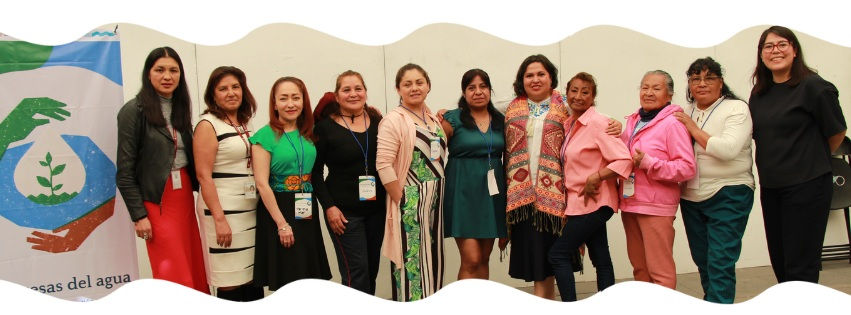
At Aguas Firmes, this approach translates into concrete actions. One of the most significant efforts is the participation of more than 25 women leaders in exchanges of good agricultural and water management practices in the three territories where solutions are being developed as part of this project: Hidalgo, Zacatecas, and Mexico City. Supported by the Gender Unit of CONAGUA and its state offices, these actions lay the groundwork for the creation of a formal network of women farmers that will be launched in 2026.
This network of women leaders will not only promote technical tools for water management, but will also strengthen organizational skills, decision-making, and community participation. So far, the participants have exchanged experiences, identified common problems, and built collective solutions from the ground up.
The impact goes beyond individual learning. When a woman strengthens her leadership on water issues, multiplier effects are generated:
Management of the resource improves in households and communities
More equitable participation in decision-making spaces is encouraged
Local networks that sustain the solutions over time are strengthened
Water, when managed equitably and sustainably, can become a lever of well-being for everyone. At Aguas Firmes we believe that lasting solutions are built collectively.
Because when water flows as it should, so do opportunities.
Tags:



Join us
Let’s build together a
future with water, a,
future with life.