Un proyecto de


A project of


Our Community


INTERNATIONAL SOIL CONSERVATION DAY
The hidden power of healthy soil: More than 600,000 tons of CO2 eq captured in the soil.
Have you ever thought about what lies beneath your feet when you walk through the countryside? We tend to look up at the sky waiting for rain, or check the level of lakes and reservoirs to measure water. However, the real secret to water and climate security is not above us, but below.
Every July 7 marks International Soil Conservation Day, a date that reminds us that beneath our feet lies one of the most important resources for securing the water of the future: the land we walk on and farm.
Two resources, one shared destiny
Water and soil are not separate elements; they are inseparable allies. Healthy soil, rich in organic matter and with a strong structure, works exactly like a natural sponge. When it rains, this soil absorbs the water, retains moisture, and allows the liquid to filter slowly down to the underground aquifers, recharging them.
For those who make their living from the land, this makes a big difference. Soil that holds moisture better helps crops withstand longer periods without rain and reduces the need for irrigation.
In contrast, when soil is degraded, compacted, or overexploited, it loses that capacity to absorb water. The water simply runs off the surface, increasing the risk of landslides, causing erosion, and evaporating before it can infiltrate to recharge the aquifers. In short: without soil conservation, there is no water sowing.
The hidden "superpower": An ally against climate change
We should know that in addition to storing water, soil is also our best shield against global warming. According to data from the FAO (Food and Agriculture Organization of the United Nations), the planet's soils hold about three times more carbon than the atmosphere. When the land is healthy and covered with vegetation, it acts as a massive "sink" that captures and stores carbon dioxide (CO₂), preventing it from rising into the atmosphere and accelerating climate change. However, when soil erodes or is overexploited, that trapped carbon is released.

Therefore, taking care of the land not only protects water, but is also one of the most effective natural strategies to reduce the concentration of carbon dioxide in the atmosphere and help mitigate climate change.
Firm Waters: Root actions to protect the land
In Firm Waters, we understand that to take care of water we must recover soil health to promote carbon storage and improve its water-retention capacity. Through our partnerships, we drive two essential fronts:
Nature-Based Solutions (NbS): In the upper basins, we implement conservation works such as infiltration trenches,gabion dams, stone barriers, and reforestation. These structures slow down water velocity and reduce erosion, creating the necessary conditions for native vegetation to thrive. By restoring vegetative cover, we increase soil organic matter and strengthen its long-term carbon capture capacity. So far, we have managed to retain 11,118 m3 of sediments. In particular,the use of live fences and contour ridges has proven to be highly effective, not only for soil containment, but as a key mechanism that maximizes carbon capture potential.
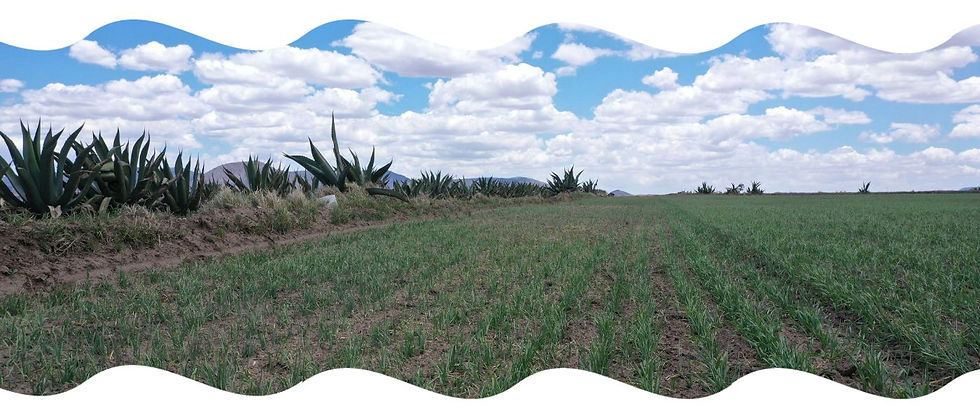
Sustainable Agriculture: We work closely with local farmers implementing Sustainable Agriculture practices (such as crop rotation and leaving crop residue on the land instead of burning it). Keeping the soil covered drastically increases organic matter, which improves moisture retention. In addition, the most conducive agronomic practices are zero tillage and minimum tillage, which show consistent long-term carbon capture increases.
With these practices and thanks to joint fieldwork, the Aguas Firmes project has recorded more than 600,000 tons of CO₂ equivalents captured, preventing their release into the atmosphere (2021-2025).
Conservation is a collective task
Each drop of rain has two paths: it can run off and be lost in a matter of minutes, or it can infiltrate slowly to become part of the water that will supply the aquifers. The difference between both paths is the health of the soil.
The soil is a finite resource: nature can take hundreds of years to create just a few centimeters of fertile land, but bad practices can destroy it in a single season.
Today, more than a celebration, International Soil Conservation Day is a reminder that every action counts. By supporting sustainable agriculture and protecting our watersheds, we are not only protecting the land that feeds us and the water that gives us life, but we are also helping to cool the planet.
Each healthy soil functions as a sponge that stores water for tomorrow and as a great natural storehouse that captures carbon.
Conserving the soil means protecting our future.
Tags: Conservation



Join us
Let’s build together a
future with water, a,
future with life.