Un proyecto de


A project of



Our Community


The Science of Fertile Soil. Promoting Resilient and Ecological Agriculture
To talk about fertilizers, we first need to talk about soil and its importance to humanity's existence for food production.
Soil is the outer, surface layer of the Earth which, over time, whether through weather effects or human action, has seen its mineral and organic particles transformed in both texture and structure. Soil is the support for trees and plants, which draw their nutrients from it.
Agricultural activities, which demand ever greater food production to meet the needs of a growing population, require tools and resources that help cover food requirements in sufficient quantity and quality; this can only be achieved with healthy, fertile soils.
How can we tell how fertile the soil is?
Thanks to tools such as fertility maps, it is possible to know the characteristics of the soil in specific areas, since they show the nutritional deficiencies and chemical constraints, making it possible to determine optimally which types of fertilizer are suitable, in what quantity, and when to apply them.
What are fertilizers?
They are substances applied artificially to the soil and to plants, providing the nutrients they need to grow and develop optimally.
Some of these nutrients are:
Nitrogen: it is the main driver of plant development and helps the absorption of other nutrients.
Phosphorus: it is essential for photosynthesis and other chemical and physiological processes. It plays an important role in energy transfer.
Potassium: it activates more than 60 enzymes that help synthesize carbohydrates and proteins, improves the plant's moisture, and increases resistance to drought and disease.
Calcium: essential for the development and growth of roots and of the cell tissue of membranes; it also helps reduce soil acidity.
Magnesium: it is the main element of chlorophyll and acts in the reactions related to the plant's energy transfer.
Sulfur: although its role is often underestimated, sulfur is a key element of proteins and chlorophyll formation.
There are many types of fertilizers, including:
Synthetic: they are chemically produced and generally contain high concentrations of nutrients, so they act quickly.
Single-nutrient / Compound: single-nutrient fertilizers contain just one nutrient, for example nitrogen, while compound fertilizers are a mix of several nutrients.
Organic (manure and compost): these types of fertilizers usually release nutrients slowly as they decompose and are made from organic matter such as manure, compost, crop residue, or bones.
These organic fertilizers are extremely valuable because they improve soil structure, regulate temperature, reduce soil erosion, retain moisture, and, as a result, make the soil more fertile. They are also cheaper than synthetic ones.
Some of the main organic fertilizers are:
Worm castings, which in addition to their nutrients provide a high concentration of microorganisms;
Manure, which is rich in nitrogen, phosphorus, and potassium. It supports plant development and is one of the most complete fertilizers;
Green manure (see article): plants grown to obtain an ecosystem service and improve soil conditions;
Bone meal, which provides large amounts of phosphorus and nitrogen, as well as balancing soil pH and encouraging plants to flower;
Crop residue, the plant cover left after harvest; it costs nothing and provides nitrogen, phosphorus, potassium, calcium, iron, sulfur, zinc, and boron, among other nutrients;
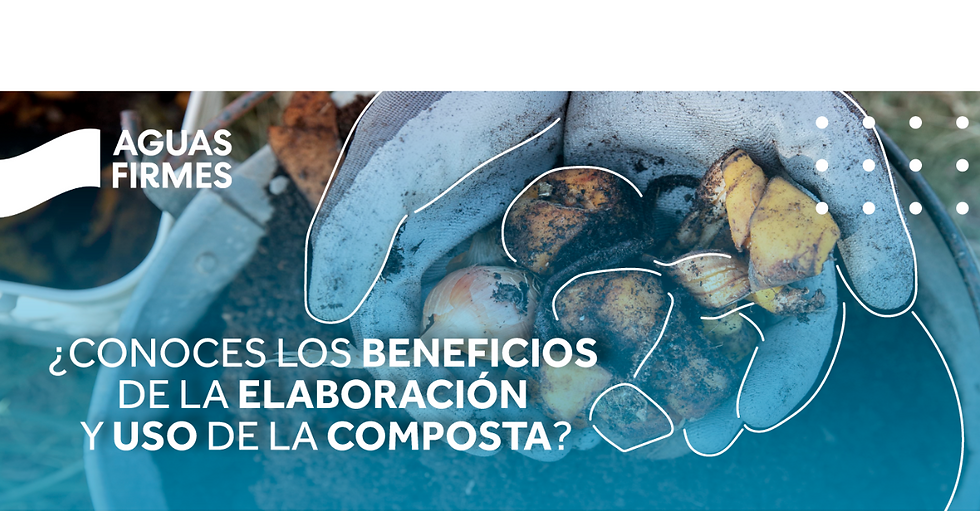
Compost is the most common organic fertilizer, both in its household version, made by separating and collecting kitchen plant waste, and in its industrial version for use on farms. It is a very practical organic fertilizer, and almost any organic matter can be composted; it also lets us help reduce greenhouse gases.
At Aguas Firmes we want to share a sustainable way to treat your organic waste and create a fertilizer of high nutritional value, by making homemade compost with this very practical and simple guide.
Making Composta
Materials needed:
A wooden container or box, preferably 70 x 70 x 70 cm, with ventilation (compost bin)
Newspaper (if the box needs to be lined); otherwise, place it in direct contact with the ground
Scissors to cut up the organic scraps
A rake to loosen and turn the soil
A watering can
Earthworms (optional)
Organic materials rich in carbohydrates, such as dry branches and leaves, pruning waste, sawdust, straw, paper, and cardboard
Nitrogen-rich materials: fruit and vegetable scraps, eggshells, coffee grounds, and tea bags
Procedure
Prepare the compost bin, either placing it in direct contact with the ground or adding about 3 to 5 cm of fertile soil at the base.
Add materials in a ratio of 1 part nitrogen-rich organic matter to 3 parts carbohydrate-rich organic matter. Shred them before adding them and before covering the compost bin with newspaper.
Mix all the elements, let them rest, and mix again every two weeks to provide air that encourages aerobic bacterial activity.
Some important notes to keep in mind when making homemade compost: moisture must be maintained by watering, and each time new waste is added it should be mixed with the older material, leaves, or straw. It is best to avoid leftovers from cooked food, pet waste, fats and oils, fish, meat, and bones.
The compost will be ready in about 4 months, when the materials added can no longer be identified; only then can it be applied to gardens or pots.
Benefits:
The soil is nourished and enriched with nutrients that are essential for plants.
It improves water retention.
We reduce the waste sent to landfills, and therefore greenhouse gas emissions are reduced.
We encourage the growth of beneficial microorganisms
The right selection of fertilizers, with correct doses, methods, and application periods, together with sustainable agricultural practices such as conservation agriculture, the choice of natural pesticides such as pheromone traps, and a modern irrigation system, is the perfect combination to contribute not only to plant health and soil sustainability, but also to obtaining more and better harvests, saving resources, and caring for the environment.

Fertile soil, the hope of prosperous harvests.



Join us
Let’s build together a
future with water, a,
future with life.